


T-Stat


-
The Most Advanced Tissue Oximeter on the Market
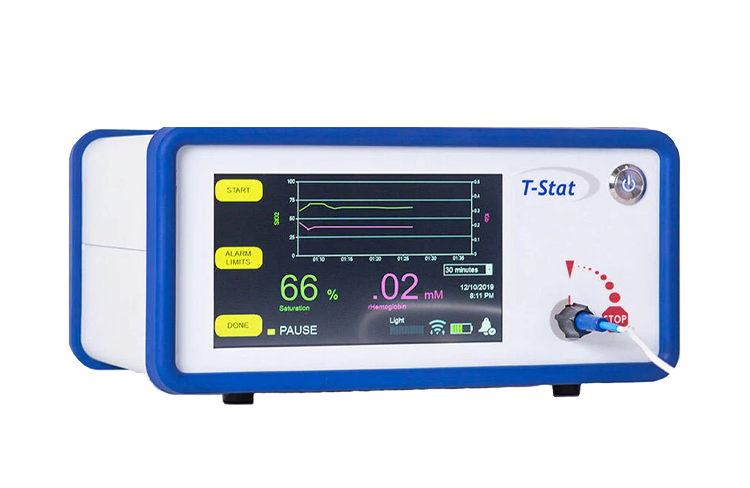
T-Stat is the first and only tissue oximeter labeled as “sensitive to Ischemia,” designed to provide continuous, non-invasive monitoring of tissue oxygenation. Using cutting-edge broadband white light and fiber optic spectroscopy, it delivers near absolute capillary-weighted oxygen saturation (StO₂%) readings. This allows surgeons to assess regional and global ischemia accurately, ensuring optimal oxygen delivery to tissue. With real-time data accessible via a secure, web-based system, T-Stat empowers clinicians to make informed decisions.
The Key Benefits of T-Stat
Unparalleled Sensitivity to Ischemia
T-Stat is the first device specifically labeled as “sensitive to Ischemia,” allowing clinicians to detect compromised tissue perfusion before visible clinical signs appear. Providing continuous, capillary-weighted oxygen saturation (StO₂%) readings enables early intervention, reducing the risk of flap failure and postoperative complications.
Continuous, Non-invasive Monitoring
With T-Stat, clinicians can monitor tissue oxygenation around the clock without disrupting the surgical site. Its non-invasive surface sensors are easy to apply, providing reliable data without causing patient discomfort or jeopardizing the tissue. This continuous flow of information minimizes the need for invasive procedures or frequent bedside checks.
Exceptional Accuracy and Reproducibility
Utilizing broadband white light technology and fiber optic spectroscopy, T-Stat delivers data within +/-2 standard deviations—providing near absolute oxygen saturation values. This level of accuracy ensures reliable, reproducible results. Clinicians can trust that T-Stat’s readings accurately reflect real-time perfusion at the microvascular level.
Versatile Sensor Options
T-Stat’s comprehensive system includes specialized sensors tailored for various clinical scenarios, including free flap monitoring, endoscopy, and critical care. Whether using the large or small surface sensors for reconstructive surgery or the endoscopic sensor for gastrointestinal assessments, T-Stat provides real-time, localized measurements.
-
The T-Stat Monitoring System
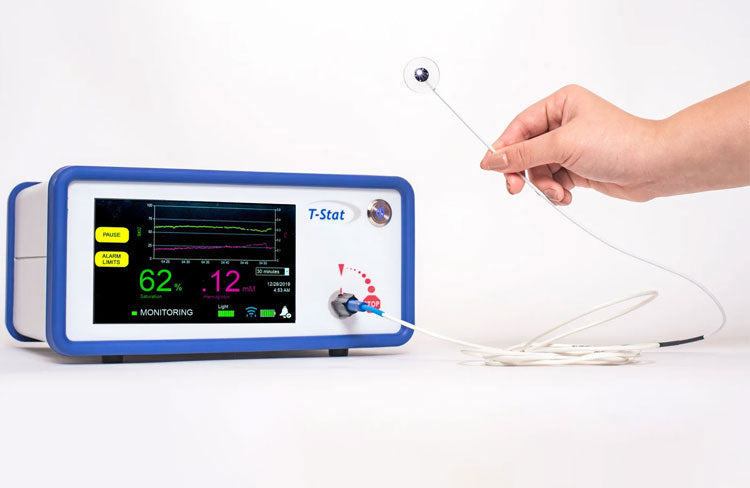
The T-Stat monitoring system is a comprehensive solution that provides continuous, non-invasive, and highly accurate tissue oxygenation measurements. At its core is the T-Stat VLS Tissue Oximeter, paired with specialized sensors tailored for various clinical applications. Each sensor utilizes advanced broadband white light technology and fiber optic spectroscopy to deliver real-time perfusion data, ensuring precise monitoring across critical care settings.
-

Large Surface Sensor (2.5cm)
The 2.5cm large surface sensor is most commonly used for monitoring free tissue flaps in reconstructive microsurgery. By measuring near absolute StO₂%, this sensor delivers immediate insights into both arterial and venous blood flow. The large surface area ensures comprehensive coverage, making it ideal for monitoring larger skin islands during reconstructive procedures.
-

Small Surface Sensor (1cm)
The 1cm small surface sensor is specifically designed for cases requiring precise monitoring of smaller tissue areas. This sensor is particularly valuable in head and neck reconstructions, where smaller skin paddles are common. Despite its compact size, it provides the same high level of accuracy and real-time data as the larger sensor.
-

Endoscopic Sensor (1.5mm)
The 1.5mm endoscopic sensor integrates seamlessly into endoscopic procedures, fitting easily through an endoscope channel. This slender, 2-meter-long sensor provides continuous, real-time StO₂% readings, enabling direct assessment of tissue perfusion. This allows clinicians to monitor oxygenation without disrupting the procedure during minimally invasive surgeries.
-

Oral Sensor
The oral sensor is uniquely designed to monitor the saturation of the buccal mucosa, serving as a non-invasive surrogate for gastrointestinal perfusion. Suitable for patients ranging from neonates to adults, it helps manage cardiac output and arteriovenous oxygen differences without the need for frequent blood draws, making it crucial in critical care settings.


Possible Clinical Applications of the T-Stat
Reconstructive Microsurgery
T-Stat plays a vital role in monitoring tissue perfusion during and after surgical procedures in reconstructive microsurgery. Its non-invasive sensors are easily placed on the tissue surface, emitting light into the flap and capturing real-time signals reflecting oxygen delivery. This immediate feedback lets surgeons detect ischemia early, minimizing flap failure risks. The device’s accuracy and reproducibility ensure consistent data, helping clinicians make confident, informed decisions throughout the perioperative period.
Endoscopy
During endoscopic procedures, the T-Stat endoscopic sensor enables localized tissue saturation monitoring with ease and precision. Its slender 1.5mm diameter allows it to pass through the working channel of an endoscope without disrupting visualization or procedure flow. Within seconds, clinicians receive continuous StO₂% readings, empowering them to make immediate, data-driven decisions. This real-time feedback is particularly valuable when tissue access is limited, ensuring patient safety and procedural efficiency.
Critical Care (NICU/PICU/ICU/CICU)
In critical care settings, including the NICU, PICU, ICU, and CICU, T-Stat delivers invaluable data for managing oxygen delivery and arteriovenous (AV) differences. Its continuous monitoring reduces reliance on frequent blood draws, improving patient comfort, especially in vulnerable pediatric populations. T-Stat closely correlates with Swan-Ganz (PAC) Svo₂ readings, providing reliable insights into systemic perfusion. FDA-approved for use for up to 30 days, it is ideal for long-term monitoring of critically ill patients.


Viewpoint Partners with Spectros to Showcase T-Stat Applications and Technologies
